When it comes to yacht interiors, choosing a sofa is rarely just about shape or color. It is about circulation. It is about how the yacht is actually used. Yet most decisions are still made based on first impression. That is where problems begin.
In 19 years in the industry, I have seen many different interiors that ultimately failed for the same three reasons. These patterns repeat themselves, regardless of budget, yacht size, or project type.
If you are planning changes on a yacht, these are three mistakes worth avoiding.
1. It is obvious that the sofa was added later
On a yacht, you immediately feel when an upholstered piece was introduced as an afterthought. Too deep. Too bulky. Pushed against the wall. Circulation tightens. The salon loses its openness. The space feels tense, even if it looks “fine.” This often happens during refits, when a ready-made piece is chosen as a quick solution.
But a yacht is not an apartment. A layout on board cannot absorb furniture that ignores its proportions. The issue is not the sofa itself. It is that it was never designed for that specific space.
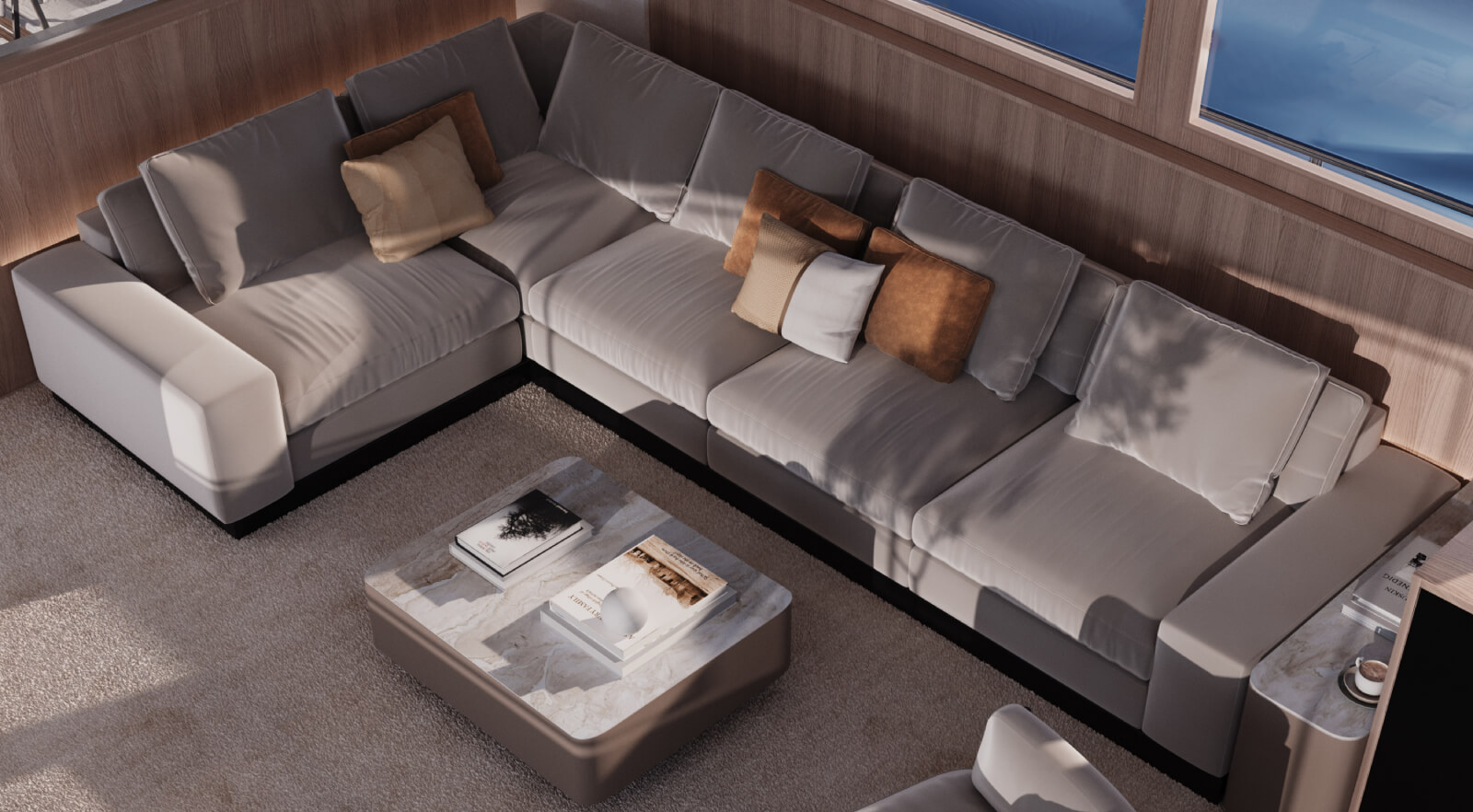
On yachts, upholstered pieces should be built to exact dimensions with clear seat depth, backrest height, proportions, and proper relation to walkways.
Such a piece can integrate storage, follow architectural lines, or continue into another element. It does not just occupy space, it defines it. Upholstered furniture on a yacht is not decoration. It is spatial planning.
2. A piece that does not belong to the whole
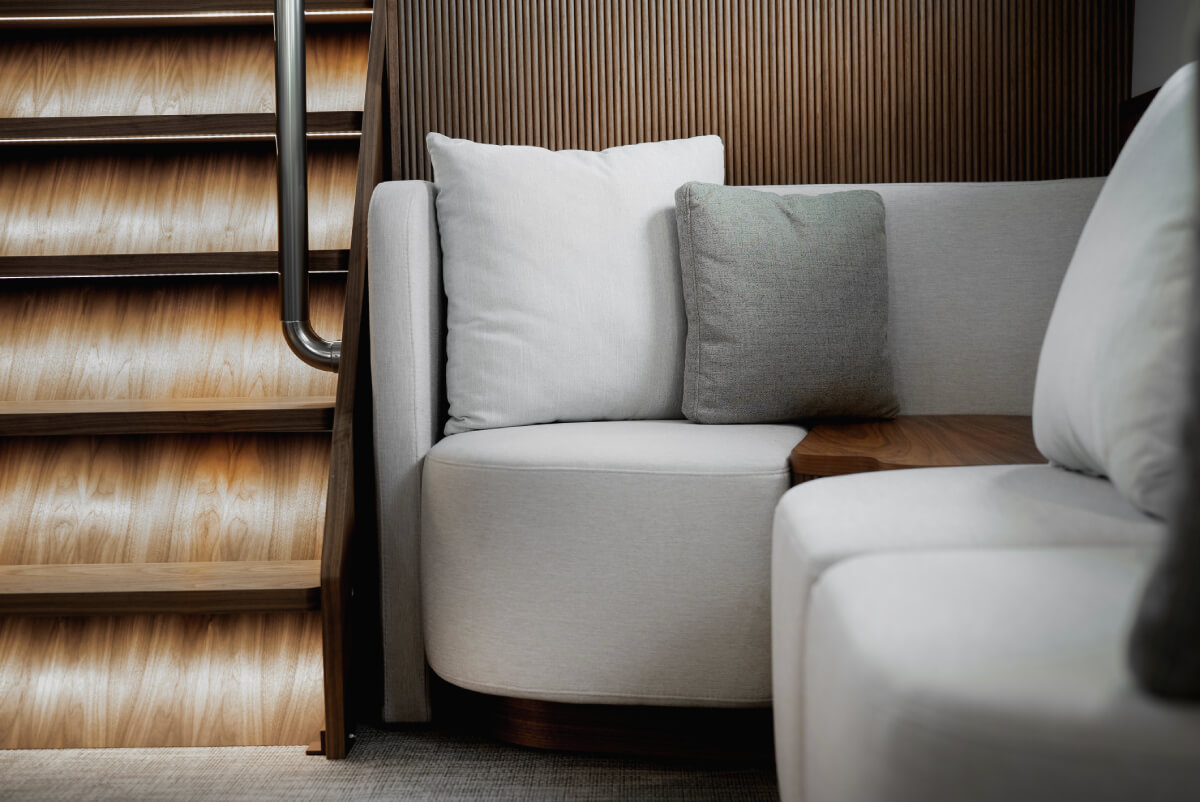
The second mistake is more subtle. The dimensions may be correct. The circulation may work. But the piece is treated as a standalone object instead of part of the interior architecture. A beautiful sofa is selected. It fits. But it does not communicate with the rest of the space.
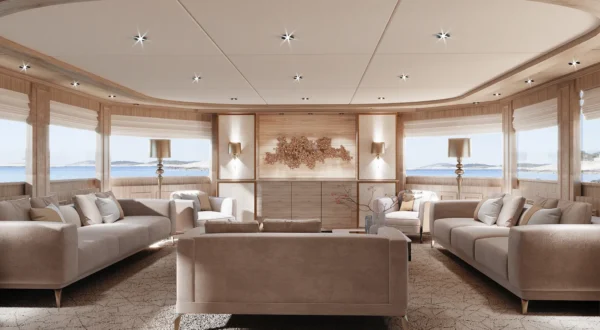
On a yacht, seating defines rhythm. It connects zones. It guides movement. When furniture is treated in isolation, the interior becomes fragmented. Each zone functions separately instead of the salon working as one cohesive whole.
When we design upholstered elements, we ask different questions: Does the seating line follow the architecture? Can it extend? Connect? Flow? Does it support the concept or interrupt it? The difference is subtle. But it is immediately felt.
3. Replacement as a first, not a last option
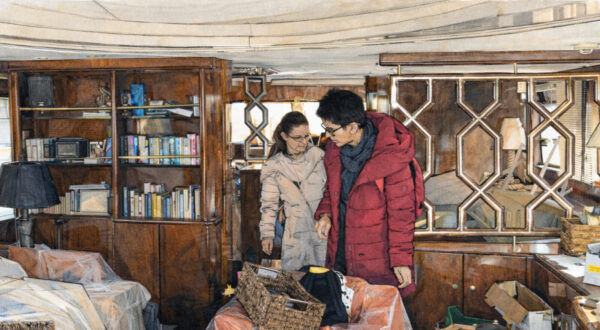
The third mistake is the most common in refits and often the most expensive. The existing furniture is structurally sound. The frames are solid. The upholstery is intact. Only the aesthetic no longer matches the owner or the charter positioning. And suddenly: everything out, everything new. In many existing interiors, there are masterfully built elements: well-crafted structures, carefully resolved proportions, and strong detailing.
When everything is removed, you also lose parts that, with minimal intervention, could elevate the new design. If the construction is good, there is no reason to discard what works. Reupholstery can give the interior a completely new identity while preserving the quality structure. With experienced craftsmen, existing pieces can be rebuilt and integrated into a new concept without unnecessary demolition and without compromise.
A refit does not mean starting from zero. It means improving intelligently.
How to avoid these mistakes
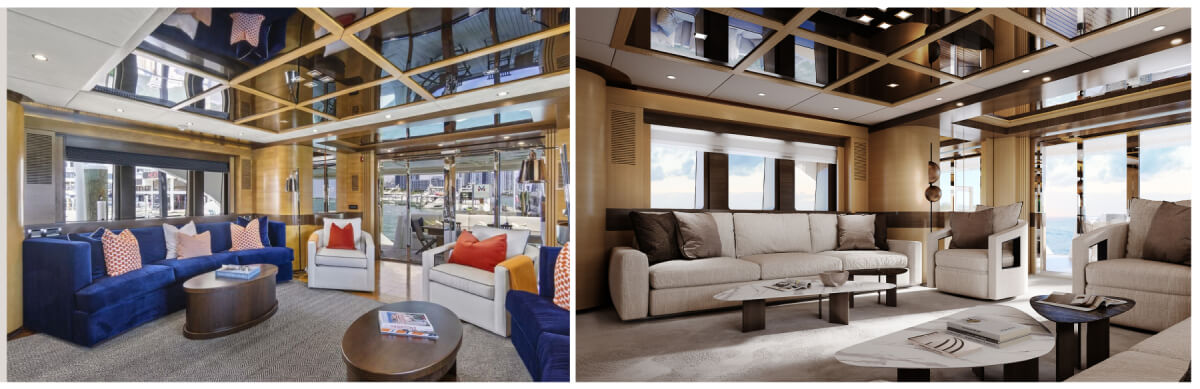
If you want to avoid all three – wrong proportions, disconnected elements, and unnecessary replacement, the key lies in the approach. On yachts, upholstered elements, sofas, armchairs, headboards, and wall panels are part of luxury. But they are never only that. They shape how the space functions, how people move, and how it feels to live on board.
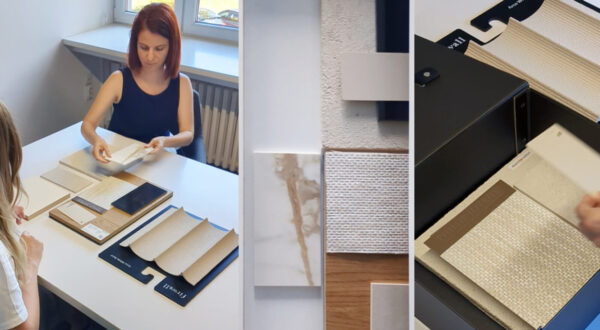
That is why, at Salt & Water, we often guide clients toward custom-built solutions. Not because they are “more luxurious,” but because they allow full control over dimensions, ergonomics, execution, and long-term performance. We follow the process from drawings to installation. Not just selecting fabrics, but working closely with craftsmen, checking dimensions, foam density, fixing systems, all the small technical details that seem minor on land but matter enormously at sea. Because on a yacht, the difference between good and exceptional is rarely what you see in photos. It is how it is built and how it performs over time.
If you are planning a yacht refit, consider how your furniture truly fits the space, before choosing what simply looks good.